The people you remember. The moments that remain. Written for readers who have finished · full-book spoilers
This illustrated book is written for readers who have finished the novel. You have set your place part-way through, so scenes from later chapters are folded away and each person is described as you first meet them.
The eldest, by Adelaïda. An ex-officer: reckless, generous, loud. Owed money by his father, engaged to Katerina, ruined by Grushenka. Convicted of a murder he did not commit.
The eldest son, by the first wife. Passed from relative to relative, now an ex-officer who believes his father owes him his mother’s money.
Not yet met at your place in the book: first appears in Bk I, ch. 2.
Boris Grigoriev · The Confession of an Ardent Heart1916–1932 · Historical illustration · Source & credits ↗Private collection · Reproduced in Sotheby’s, 2007
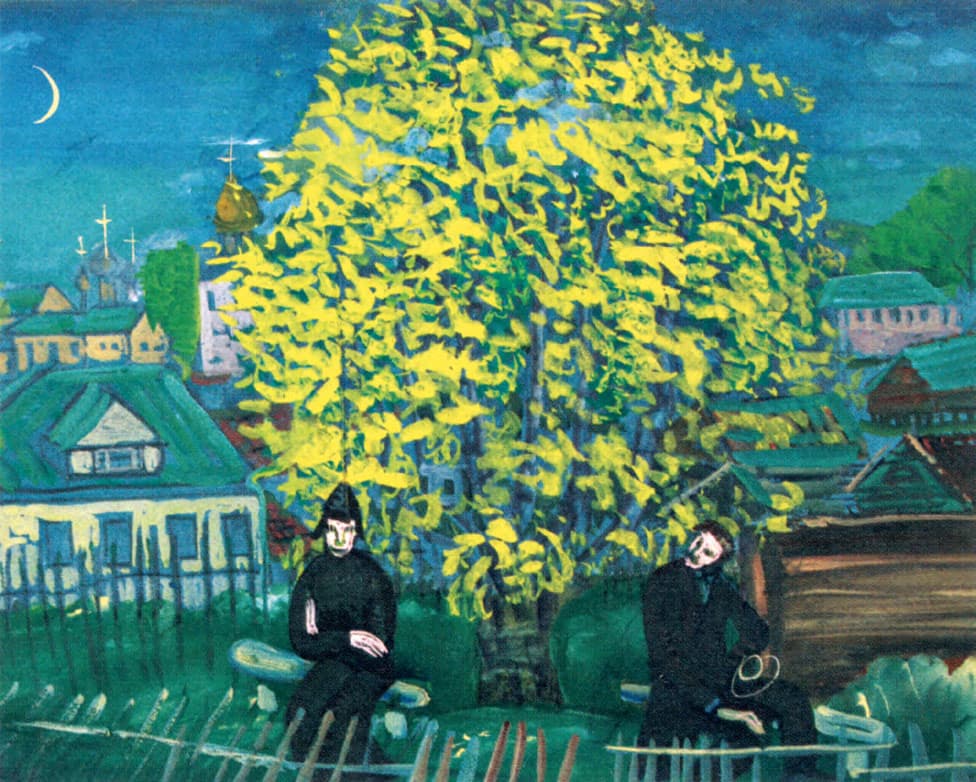
A scene remembered · Bk III, ch. 3
The confession of a passionate heart
In the garden, Dmitri pours out his heart to Alyosha. Poetry gives way to confession: his longing for beauty, his shame, and the story of the two women between whom his life is divided.
Look closely
The luminous tree fills the space between the brothers; their dark figures sit apart beneath it.
Why it matters
Dmitri trusts Alyosha with the contradictions that others will later flatten into a story of guilt. The confession continues through the next two chapters.
Agrafena Alexandrovna. Brought to town by the merchant Samsonov at eighteen and kept by him since. Courted by father and son at once — which is what sets the murder in motion.
Agrafena Alexandrovna. Kept for years by an old merchant, and the woman both Dmitri and his father are pursuing.
Not yet met at your place in the book: first appears in Bk III, ch. 5.
Boris Grigoriev · Delirium1916–1932 · Historical illustration · Source & credits ↗Private collection · Reproduced in Sotheby’s, 2007
A scene remembered · Bk VIII, ch. 8
Delirium
At Mokroye, the revelry grows feverish. Two girls dressed as bears tumble before the crowd while Dmitri and Grushenka imagine a life together. Before the night is over, the officers arrive to arrest him.
Look closely
The tumbling bear costumes and crowded faces turn the celebration into a scene of almost uncontainable motion.
Why it matters
Dmitri and Grushenka briefly imagine a future together. The arrest interrupts that possibility, turning a night of release into the beginning of his trial.
The household’s cook, epileptic and contemptuous. Born to Lizaveta in the garden; the town assumes Fyodor is the father. He listened to Ivan more carefully than Ivan did.
The household’s cook, raised by Grigory and trained in Moscow. Silent, fastidious about his clothes, contemptuous — and subject to fits.
Not yet met at your place in the book: first appears in Bk III, ch. 6.
Boris Grigoriev · Smerdyakov with a Guitar1916–1932 · Historical illustration · Source & credits ↗Private collection · Reproduced in Sotheby’s, 2007
A scene remembered · Bk V, ch. 2
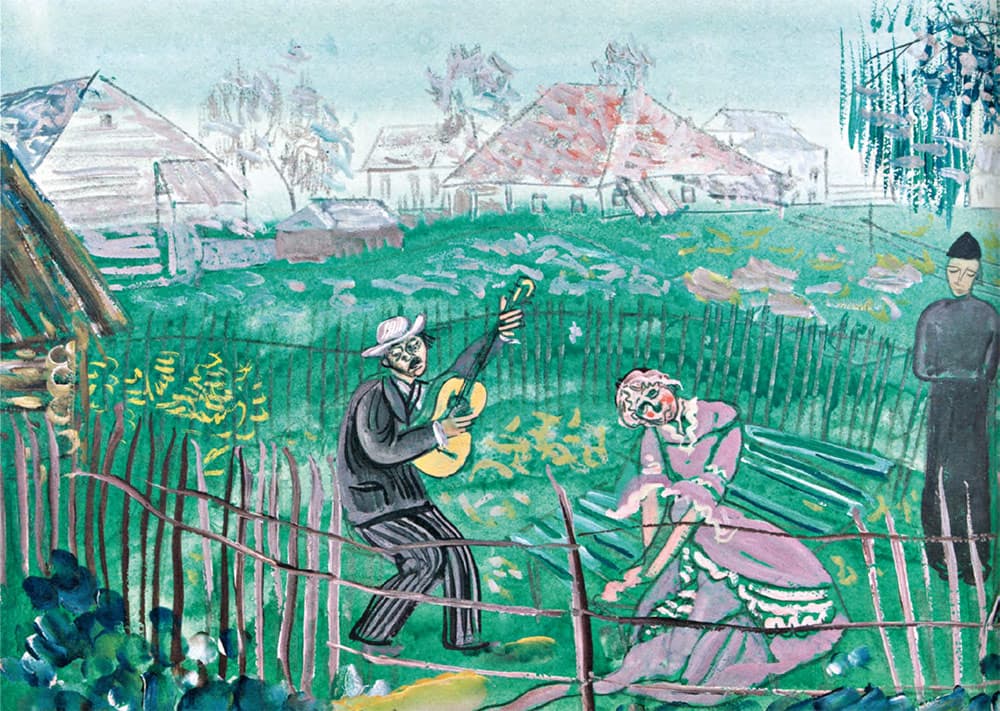
Smerdyakov with a guitar
Searching for Dmitri, Alyosha overhears Smerdyakov singing to Marya Kondratyevna. The cook’s talk is full of resentment and disdain. When Alyosha interrupts, he learns where to look for Ivan.
Look closely
Follow the guitar toward Marya on the bench, then notice Alyosha standing just outside their conversation.
Why it matters
The servant at the edge of the family has a voice of his own. His resentment matters long before the brothers understand how closely he has been listening.
The father. A buffoon and a sensualist who forgot his children entirely, then competed with his eldest son for the same woman. Murdered in his own house.
The father. A landowner, buffoon and sensualist who made money, married twice, and forgot all three of his sons.
Not yet met at your place in the book: first appears in Bk I, ch. 1.
Boris Grigoriev · Drinking Cognac1916–1932 · Historical illustration · Source & credits ↗Private collection · Reproduced in Sotheby’s, 2007
A scene remembered · Bk III, ch. 8
Over the brandy
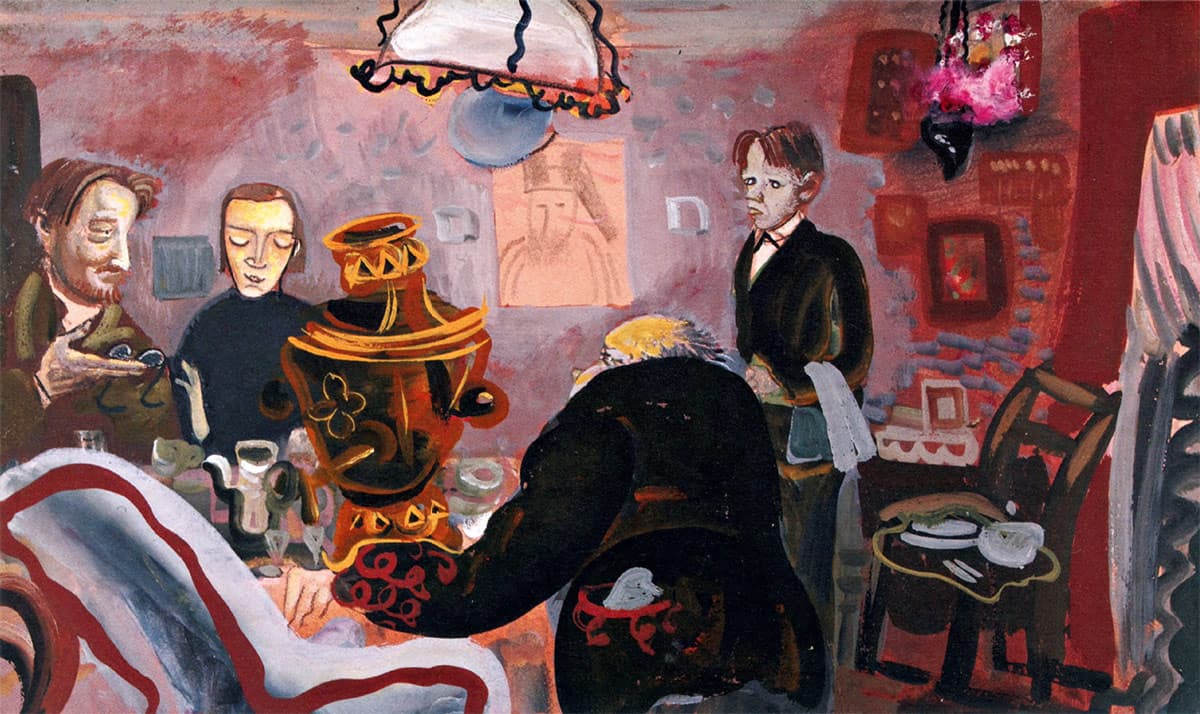
At the family table, Fyodor turns the conversation toward God and immortality. Ivan denies what Alyosha affirms. Drink loosens the father’s tongue, and his mockery of the past wounds the sons in front of him.
Look closely
The huge samovar crowds the table, while faces and bodies pull the gathering in different directions.
Why it matters
Questions about belief are already questions about how these people treat one another. The family’s cruelty gives the argument its force.
Proud and rich. Engaged to Dmitri out of gratitude for a humiliation she never forgave, while in love with Ivan. Her letter destroys Dmitri at the trial.
A proud colonel’s daughter. Dmitri tells how he once saved her family’s honour in a way that humiliated her; she became his fiancée.
Not yet met at your place in the book: first appears in Bk III, ch. 4.
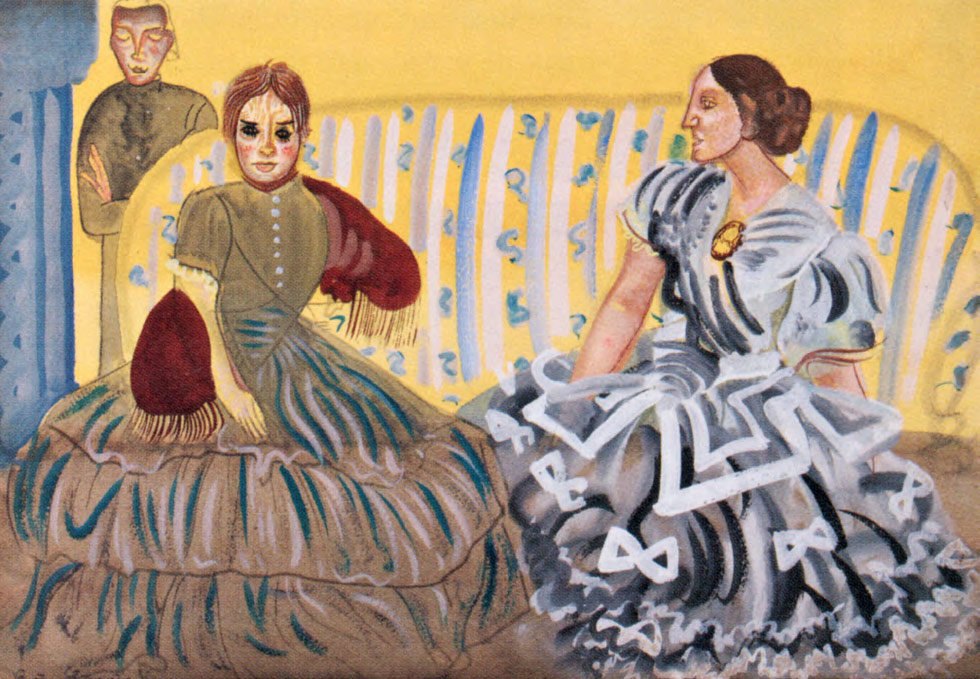
Boris Grigoriev · Both Together1916–1932 · Historical illustration · Source & credits ↗Private collection · Reproduced in Sotheby’s, 2007
A scene remembered · Bk III, ch. 10
Both together
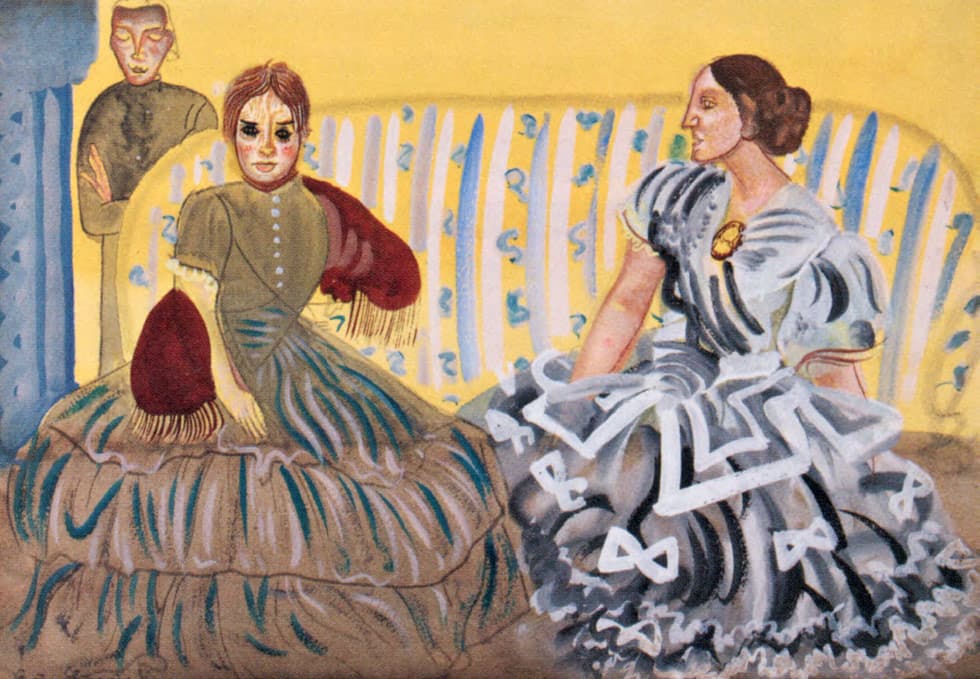
Alyosha finds Katerina and Grushenka together. An apparent reconciliation turns into an exchange of humiliations: a hand kissed, a kiss withheld, and Dmitri’s future hanging between them.
Look closely
The women occupy the sofa while Alyosha stands behind: he can witness the contest, but cannot prevent it.
Why it matters
What begins as generous courtesy exposes wounded pride. Alyosha sees how quickly the wish to be loved becomes the wish to humiliate.
The elder, and Alyosha’s teacher. His answer to Ivan is that every one of us is responsible to all men for everything. He sends Alyosha out into the world.
The elder of the monastery, sought out by crowds for his counsel. Alyosha’s teacher.
Not yet met at your place in the book: first appears in Bk I, ch. 5.
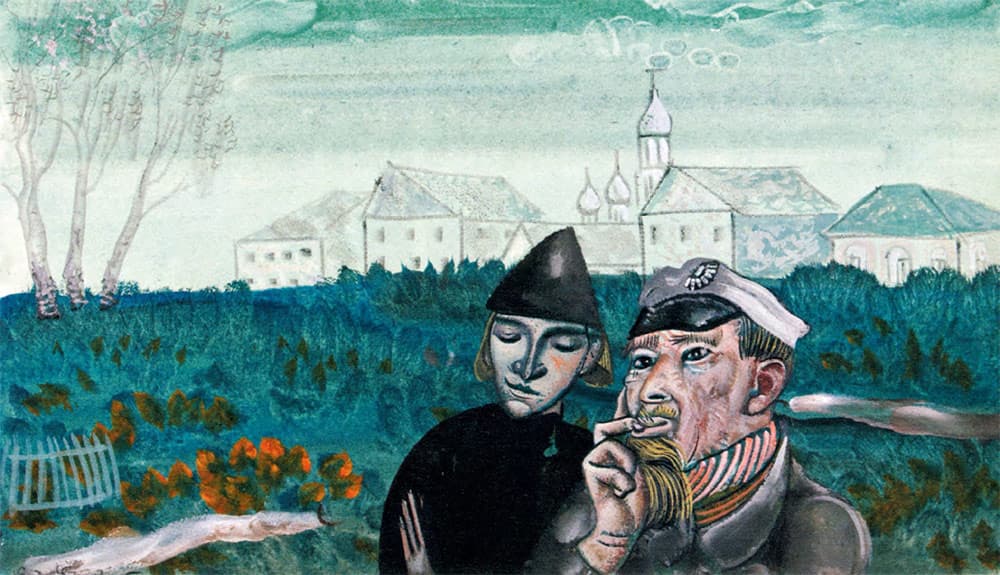
Boris Grigoriev · Alyosha and Captain Snegiryov1916–1932 · Historical illustration · Source & credits ↗Private collection · Reproduced in Sotheby’s, 2007
A scene remembered · Bk IV, ch. 7
Alyosha and Captain Snegiryov
Out in the open air, the captain tells Alyosha how Dmitri’s cruelty humiliated him before his son. Two hundred roubles seem to promise a new life for the family—until wounded pride makes him stamp the notes into the earth.
Look closely
The captain’s fingers rise to his mouth; beside him, Alyosha’s lowered eyes make the encounter unusually intimate.
Why it matters
The money could rescue the household, but accepting it feels like another humiliation. Alyosha has to learn that help must leave room for dignity.
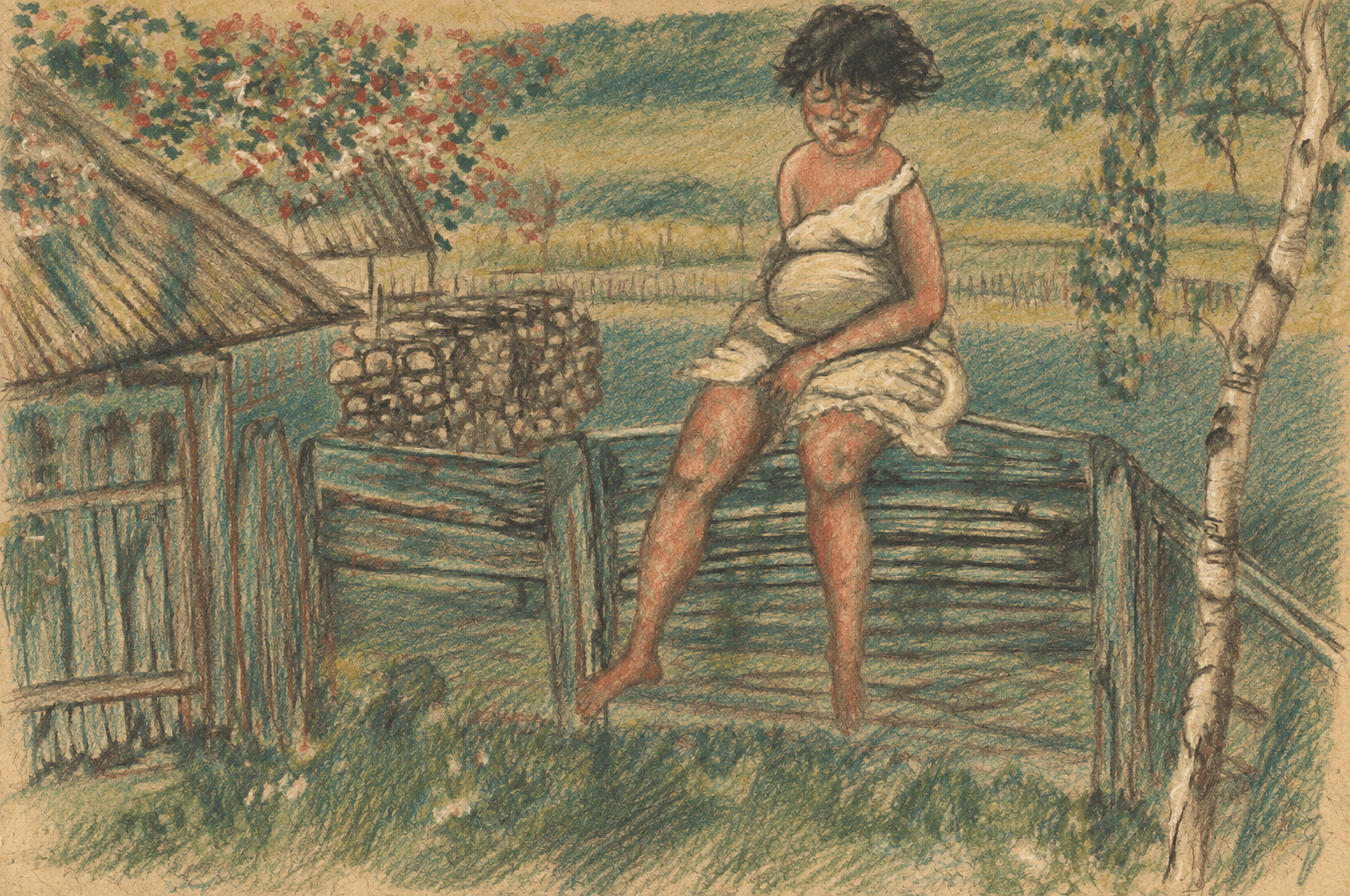
Lizaveta Smerdyastchaya — a mute, homeless girl of the town. She climbed into the Karamazov garden to give birth and died doing it. Smerdyakov takes his name from her.
Lizaveta Smerdyastchaya — a mute, homeless girl of the town who slept wherever she lay down. She climbed into the Karamazov garden to give birth and died there.
Not yet met at your place in the book: first appears in Bk III, ch. 2.
A blessing, a humiliation, a promise overheard. These illustrations lead us back to the moments that bind the Karamazovs together. Follow five movements through the novel, or pause with a single picture. The notes discuss the whole story, including its ending.
Movement I
A town, a house, a childhood
Before the crime, there is a world to remember: familiar streets, neglected children, and the rooms in which a family learns to live apart.
“A fine, warm and clear day…”
Boris Grigoriev · Extract from the supplied collage
The town is more than a backdrop. Visits, errands and overheard stories carry the Karamazovs’ private troubles into public life. This panorama lets us begin at that wider scale. Its published title gives us a warm, clear day, not a securely identified episode.
Looking closely
The row of houses stands above a line of trees; small figures occupy the open ground below.
Remember this
Keep the town in view: the family’s most private quarrels will eventually be repeated, interpreted and judged by others.
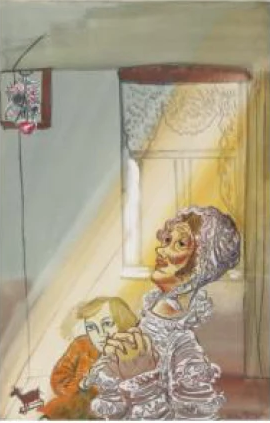
Alyosha loses his mother before his fourth birthday, yet one evening stays with him: sunlight, an icon, and her arms holding him close in prayer. Long before he enters the monastery, love and fear are already joined in his earliest surviving memory.
Looking closely
A diagonal shaft of sunlight crosses the room toward the mother and child gathered beneath the bright window.
Remember this
Alyosha’s tenderness has a history. His faith begins here as something felt and remembered, before it becomes an argument.
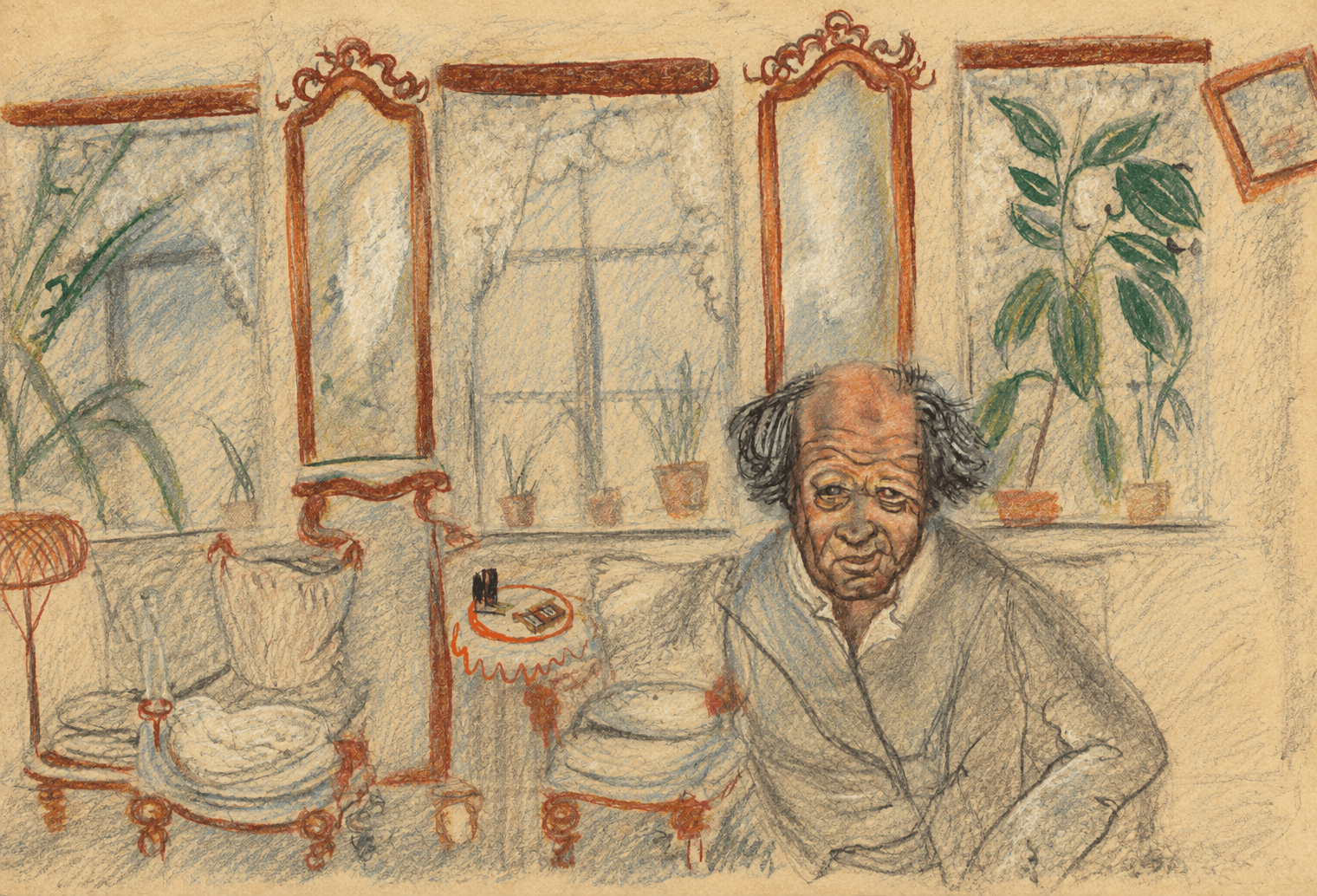
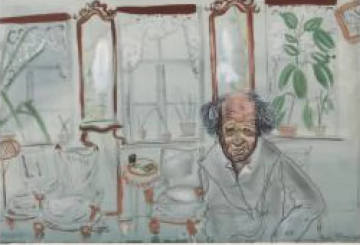
Fyodor Pavlovitch can accumulate money while neglecting the people who depend on him. His household combines comfort with disorder, affection with mockery. This portrait gives the family’s disruptive centre a domestic setting: the father is at home, but his sons have never found much shelter there.
Looking closely
Tall mirrors fill the wall behind the seated figure; pale chairs and houseplants crowd the edges of his room.
Remember this
The inheritance dispute is also a dispute about fatherhood: what does a parent owe beyond the money he keeps?
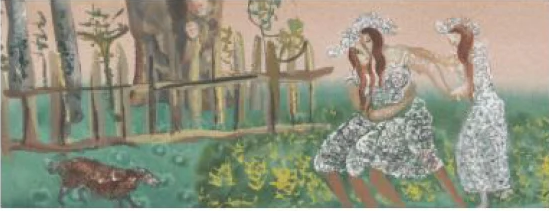
Two young figures and a small animal interrupt the succession of troubled interiors. The published title names Katya the schoolgirl, but does not securely place this scene in a chapter. We leave that connection open, rather than turn a shared first name into Katerina Ivanovna’s biography.
Looking closely
Two figures in patterned dresses stand beside a wooden fence, with a small brown animal crossing the grass.
Remember this
The title is established; the episode is not. Let the image widen the world without supplying a story we cannot verify.
Money can look like rescue, gratitude like devotion, and tenderness like a contest. Remember what each person wants the other to acknowledge.
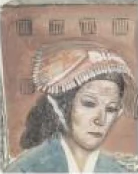
Katerina Ivanovna
Boris Grigoriev · Extract from the supplied collage
Open image ↗A generated study of this plate · AIAI-generated, not by Grigoriev — made from the small collage extract above, and not a restoration of it. Enlarged about eight times: every fine detail of the face, the headscarf, the barred windows and the brickwork is generated. Do not use it to identify the scene.
Illustration 13
Katerina, before the testimony
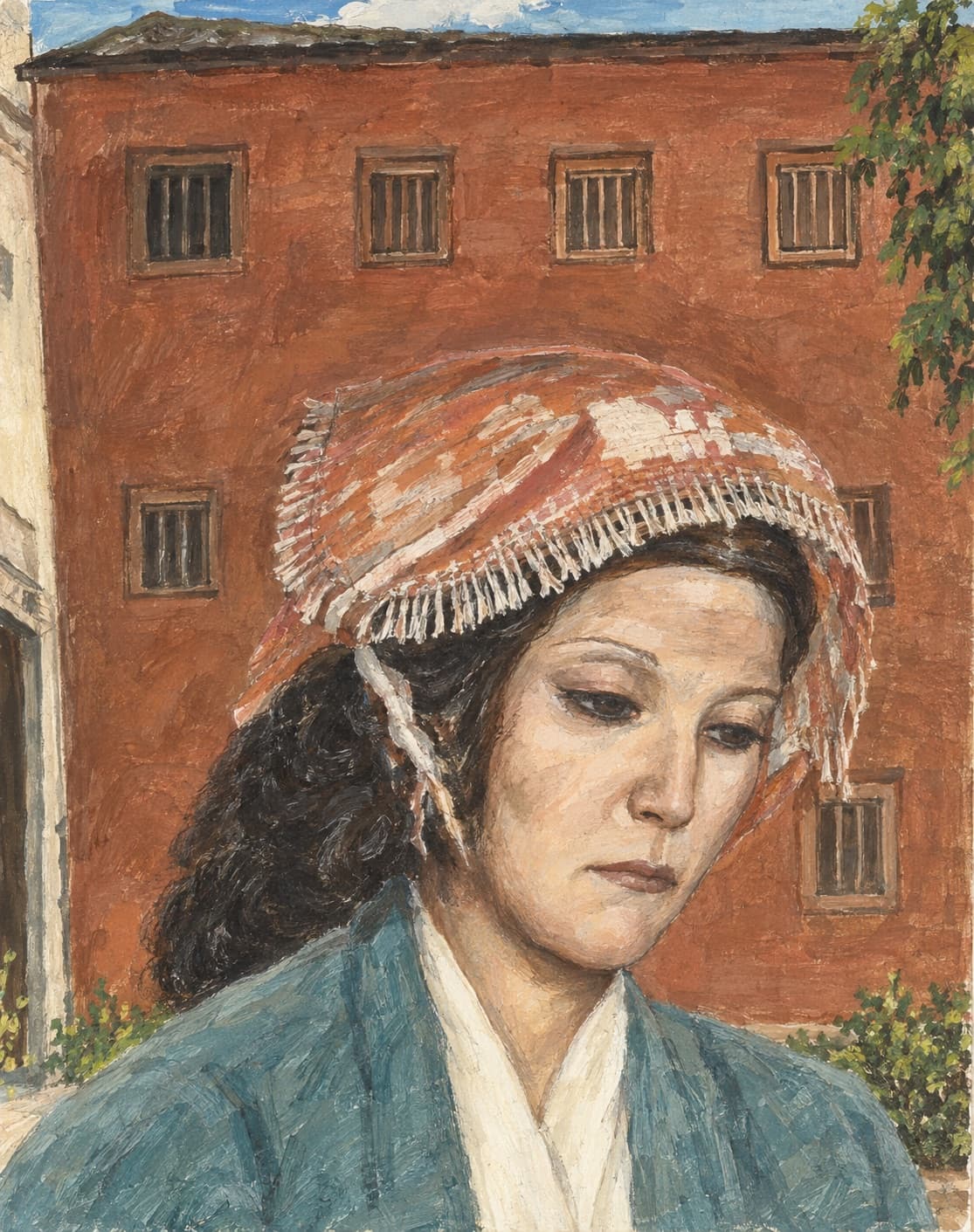
Katerina is not merely the woman Dmitri leaves. Her attachment carries the memory of a desperate appeal, an unexpected gift, and a debt she cannot treat as settled. Read this quiet portrait beside her history: generosity and wounded pride will repeatedly change places.
Looking closely
Her eyes turn downward beneath the brim of a pale hat; the small portrait holds her apart from any scene.
Remember this
Katerina’s later decisions grow from this unresolved debt. To help Dmitri can also mean insisting that he needs her.
Illustration 13 is folded away: it comes from Bk III, ch. 4, past your place.
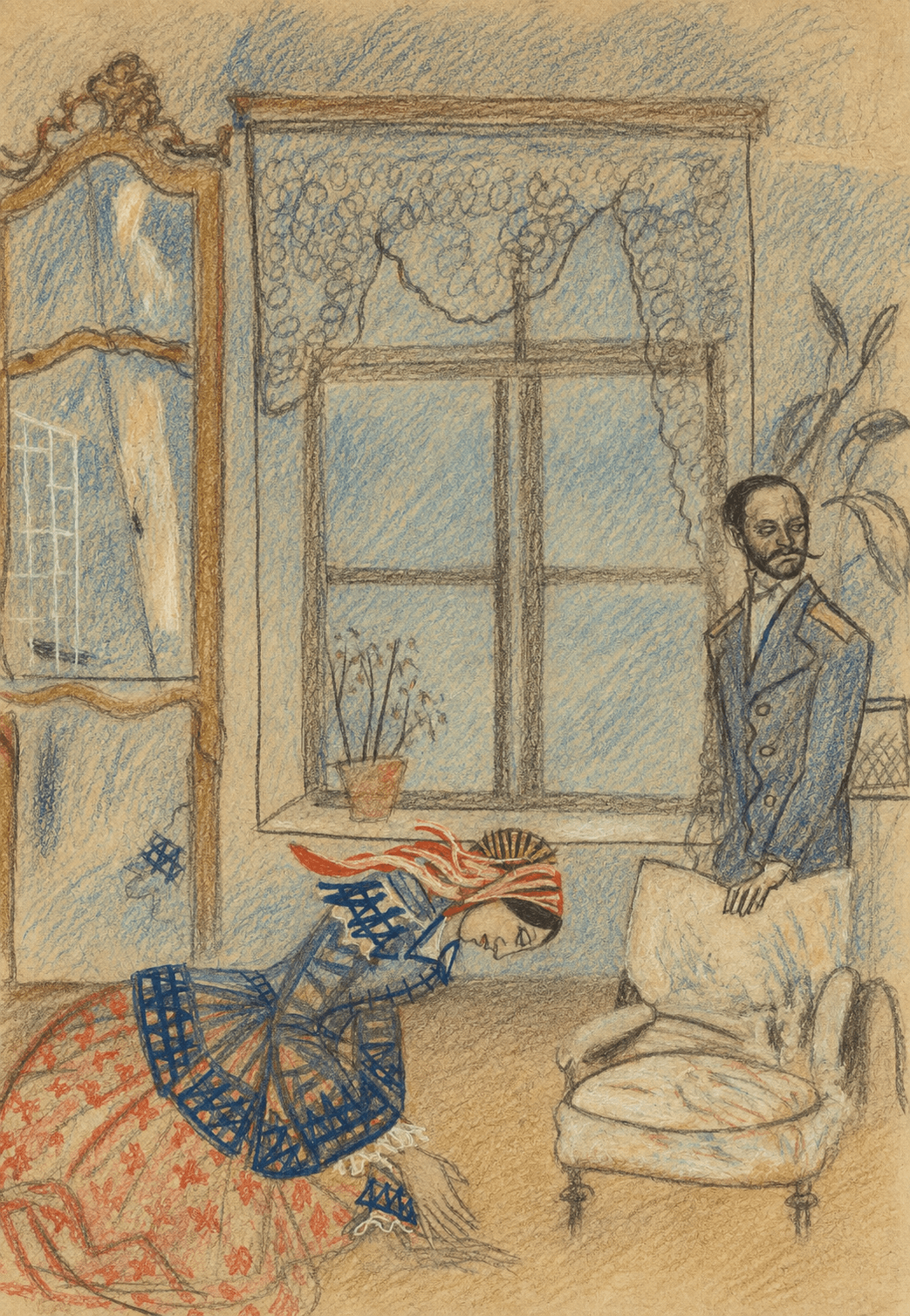
Katerina Ivanovna and Dmitri
Boris Grigoriev · Extract from the supplied collage
Open image ↗A generated study of this scene · AIAI-generated, not by Grigoriev — made from the museum’s reproduction of this illustration, and not a restoration of it. Redrawn in coloured pencil from the museum’s reproduction, keeping the two figures, their poses, the mirror and the window; the hatching and the warm paper are the generator’s. Do not use it to identify the scene.
Illustration 06
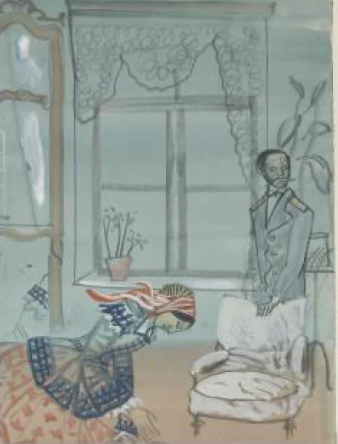
The gift and the bow
Katerina comes to Dmitri for money to save her father from disgrace. Dmitri has imagined exploiting her desperation, but instead gives her the money and lets her go. Her bow of gratitude becomes a memory neither can escape: an act of help already burdened by humiliation.
Looking closely
Katerina bends almost to the floor while Dmitri remains upright; an empty chair separates their bodies in the pale room.
Remember this
Remember the bow when Katerina enters the courtroom. What began in private will be told again before strangers.
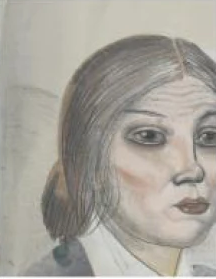
Father and son treat Grushenka as the answer to their desires. Her own story is less convenient: an old abandonment, years of resentment, and a capacity for unexpected kindness. When Alyosha comes to her in grief, the supposed temptation becomes an encounter of mutual compassion.
Looking closely
The face nearly fills the sheet; dark eyes and a tightly held mouth leave little space for setting or spectacle.
Remember this
Grushenka is not simply the prize in a quarrel. The encounter with Alyosha changes how both characters see themselves.
Katerina welcomes Grushenka as though an understanding between them could settle Dmitri’s future. She kisses her rival’s hand. Grushenka offers to return the gesture, then refuses. Alyosha watches an apparent reconciliation become a humiliation: the contest is now about who has power to wound.
Looking closely
The two women share a striped sofa but turn differently toward one another; Alyosha stands small behind them.
Remember this
The missing kiss matters more than the polite words. A small gesture exposes the struggle beneath their apparent intimacy.
Illustration 17 is folded away: it comes from Bk III, ch. 10, past your place.
Movement III
What tenderness must survive
Alyosha carries the elder’s teaching into drawing rooms and sickrooms. These images belong together through that trial of care, not because they illustrate a single day.
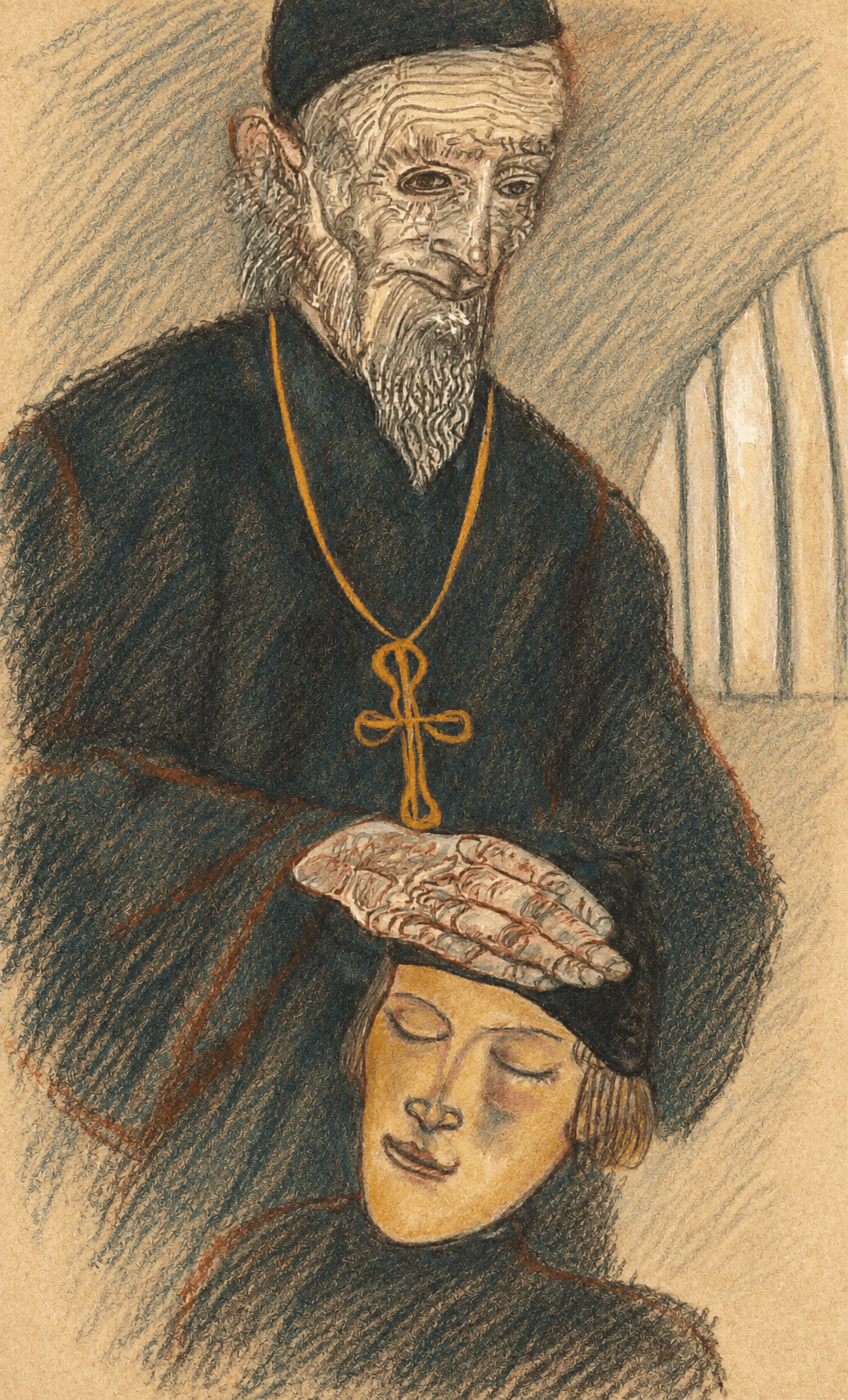
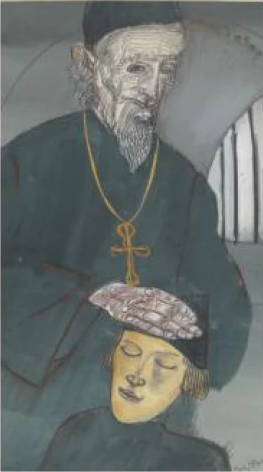
Zossima blesses Alyosha
Boris Grigoriev · Extract from the supplied collage
Zossima gives Alyosha affection, but not permission to withdraw from everyone else. In their last conversations he urges him to seek Dmitri and attend to the suffering ahead. The blessing is a beginning of responsibility: what Alyosha receives in the cell must become care outside it.
Looking closely
The elder’s large hand rests on the bowed head; the gold cross hangs immediately above their point of contact.
Remember this
Zossima’s influence survives less as a doctrine Alyosha repeats than as a way of approaching people who need him.
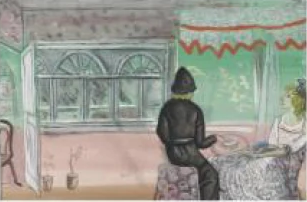
At the Hohlakovs’, talk of miracles and family scandal meets the smaller urgency of Alyosha’s injured finger. Lise interrupts the conversation to have it washed and dressed. The household gives his journey another scale: beside the great questions, there is someone immediately in need of care.
Looking closely
Alyosha’s dark robe interrupts the pale patterned interior; the window and crowded table draw attention to the domestic setting.
Remember this
This is related reading, not a claim that the crop depicts the wound. Small acts of care anchor the visit.
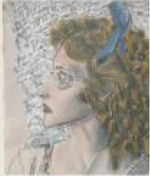
Lise can tease Alyosha, worry over his pain, and listen closely as he describes another family’s humiliation. Their childhood friendship briefly opens toward a shared future. Keep that capacity for fellow feeling beside this profile; it makes her later wish to hurt herself and others more troubling.
Looking closely
The profile turns toward the left edge; a blue ribbon gathers the curls behind the sharply outlined cheek.
Remember this
Do not reduce Lise to her later cruelty. Her earlier concern for suffering people is part of the same character.
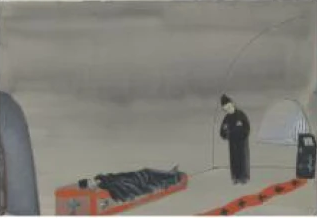
After Zossima’s death, visitors expect his body to affirm his holiness. Instead, its decay becomes a scandal. Alyosha grieves not only for his teacher but at the delight others take in his humiliation. Faith must survive without the reassuring sign that the crowd has demanded.
Looking closely
The body and the standing mourner are separated by bare grey space; the red coffin supplies the strongest colour.
Remember this
This loss tests Alyosha’s expectations of goodness. The elder’s death does not spare him the difficulty of living his teaching.
Later, Lise rejects the future she imagined with Alyosha and speaks of wanting destruction rather than happiness. He listens, but cannot simply soothe her distress away. The published composition includes both of them; this collage preserves only her side, making the room feel more solitary still.
Looking closely
Lise sits low beside a table beneath a large window; the other listener falls outside this partial reproduction.
Remember this
Her distress resists a tidy explanation. The scene asks what compassionate attention can do when it cannot immediately heal.
Illustration 24 is folded away: it comes from Bk XI, ch. 3, past your place.
Movement IV
At the door, at the window
The house narrows into thresholds: a servant who knows the signals, a father waiting for a visitor, a son preparing to leave. What remains unsaid begins to matter.
Pavel Smerdyakov
Boris Grigoriev · Extract from the supplied collage
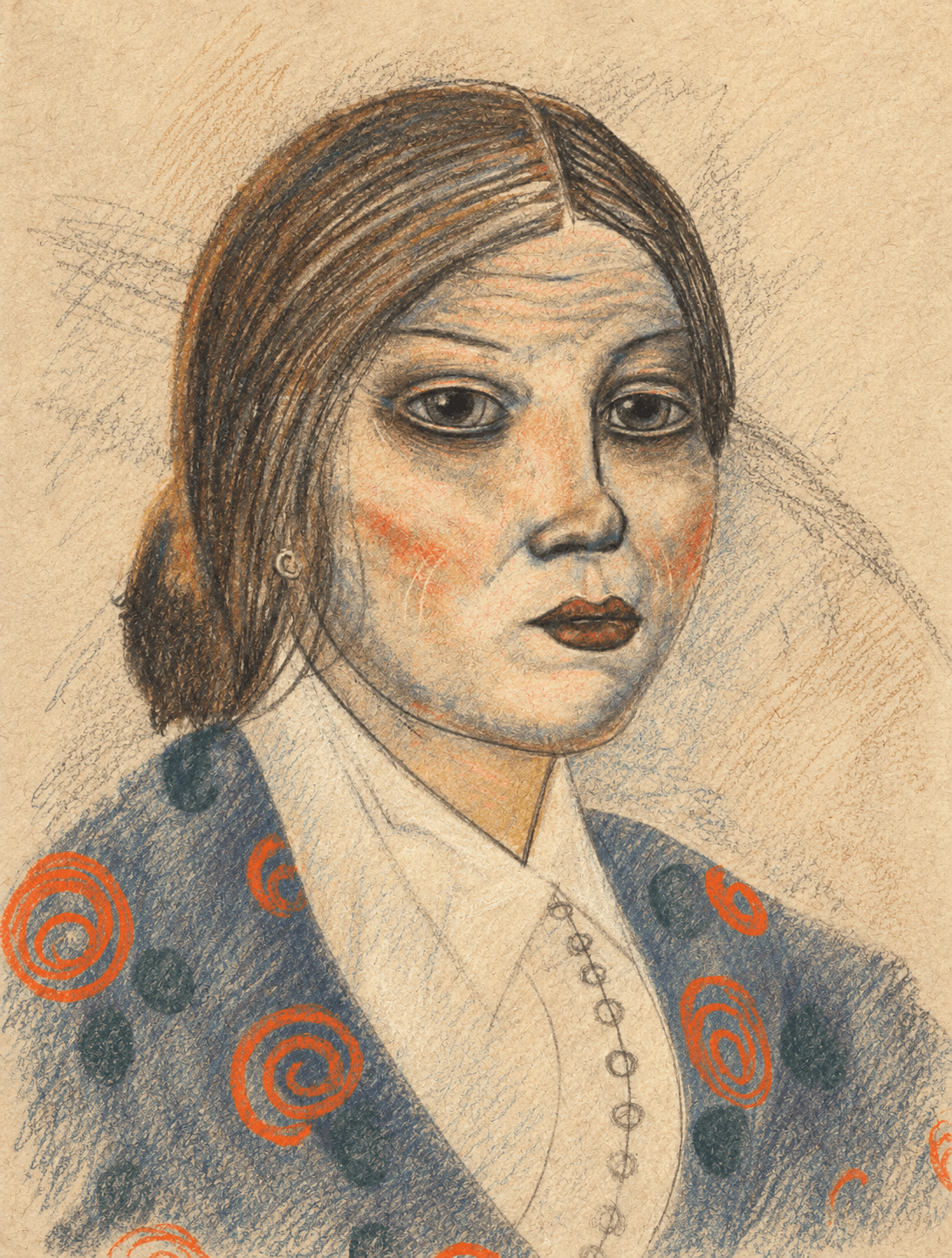
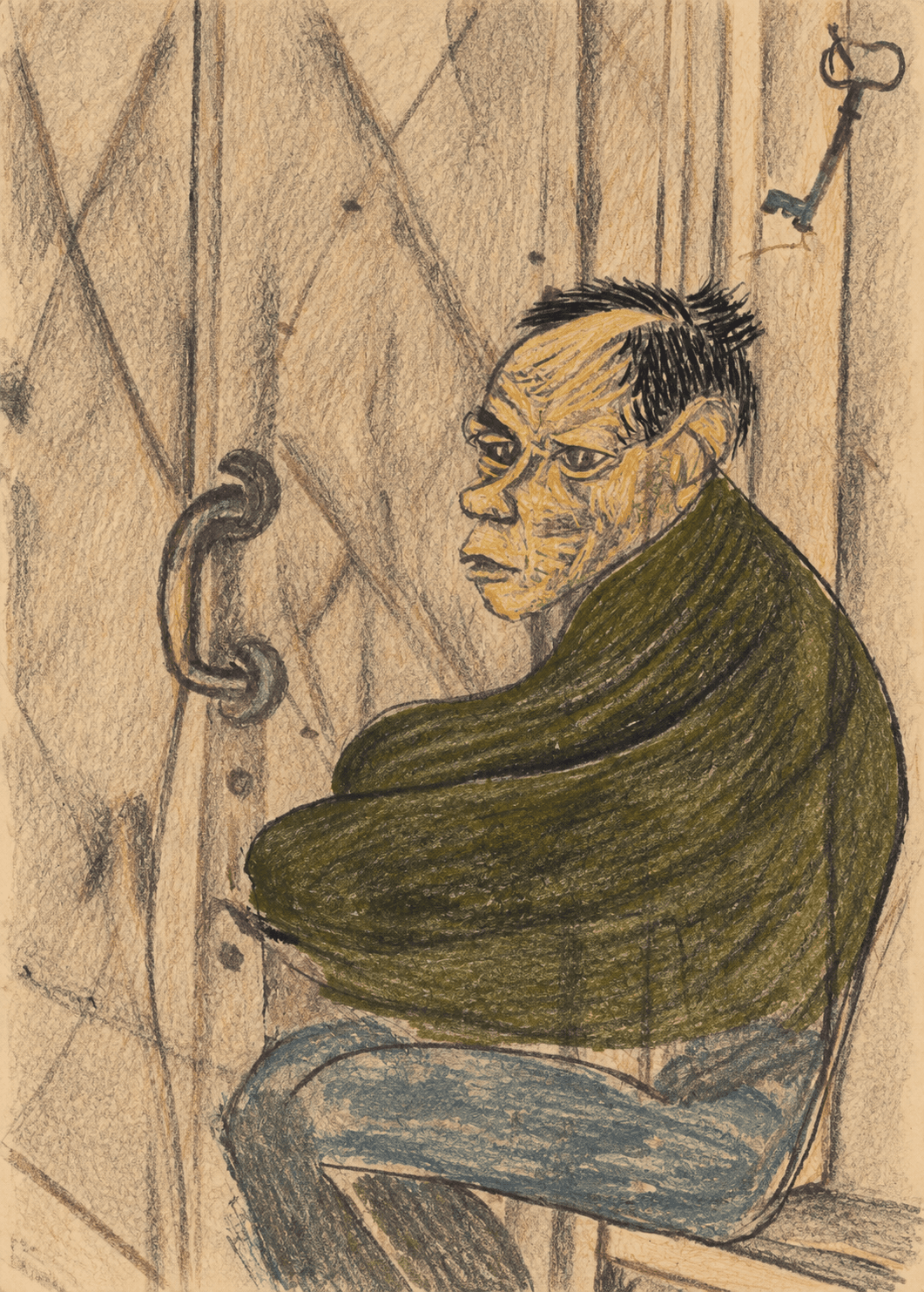
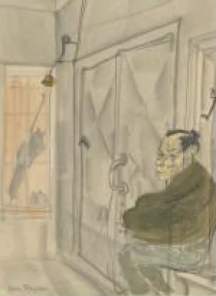
Smerdyakov is raised by Grigory and Marfa and serves in Fyodor’s house, where his skill as a cook does not protect him from contempt. His reserve encourages others to underestimate him. Keep him in view: the man at the edge of family conversation is listening closely.
Looking closely
Seated beside a tall wooden door, Smerdyakov turns his head back toward us while his body remains facing away.
Remember this
Smerdyakov’s knowledge of the household matters. The people who dismiss him repeatedly entrust him with their secrets and desires.
Illustration 36 is folded away: it comes from Bk III, ch. 6, past your place.
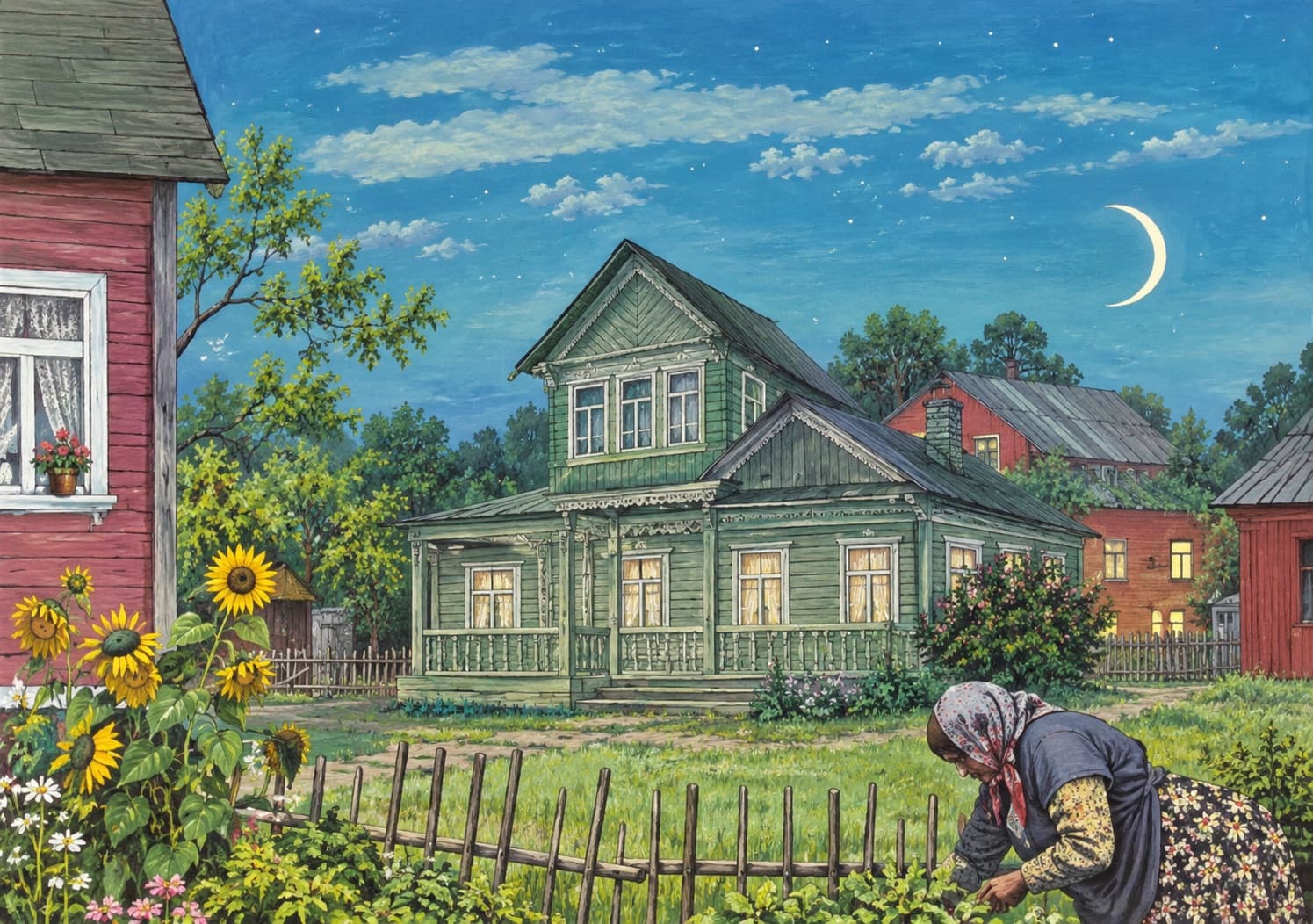
“What if Grushenka comes today…”
Boris Grigoriev · Extract from the supplied collage
Open image ↗A generated study of this plate · AIAI-generated, not by Grigoriev — made from the small collage extract above, and not a restoration of it. The extract already has the house, the crescent moon, the sunflowers and the old woman at the fence; the study sharpens them and adds the carpentry, the lit windows, the flowers and the texture of oil paint. Do not use it to identify the scene.
Illustration 02
The visitor who never arrives
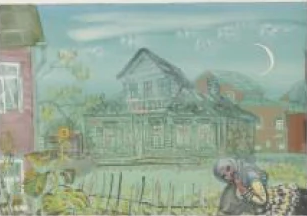
Fyodor’s expectation of Grushenka reorganises the household. He waits, questions Smerdyakov, and arranges secret signals for her arrival. Dmitri is watching too. The moonlit house belongs to that atmosphere of anticipation, where an imagined visit can govern the actions of people who have not met.
Looking closely
A crescent moon hangs above the timber house; the fence and small foreground figures keep us outside its rooms.
Remember this
Grushenka’s absence is active in the plot. Father and son make dangerous decisions around what they imagine she will do.
In the garden, Dmitri watches his father and cannot decide whether Grushenka is inside. He knocks the agreed signal. Fyodor opens the window in eager expectation, while Dmitri remains hidden. The moment brings desire and hatred face to face, without yet telling the whole story of the murder.
Looking closely
An open shutter and arched frame surround Fyodor’s face; the red head covering stands out against the dark exterior.
Remember this
Dmitri’s violent feeling is not proof of the murder. The novel makes us distinguish an impulse from an act.
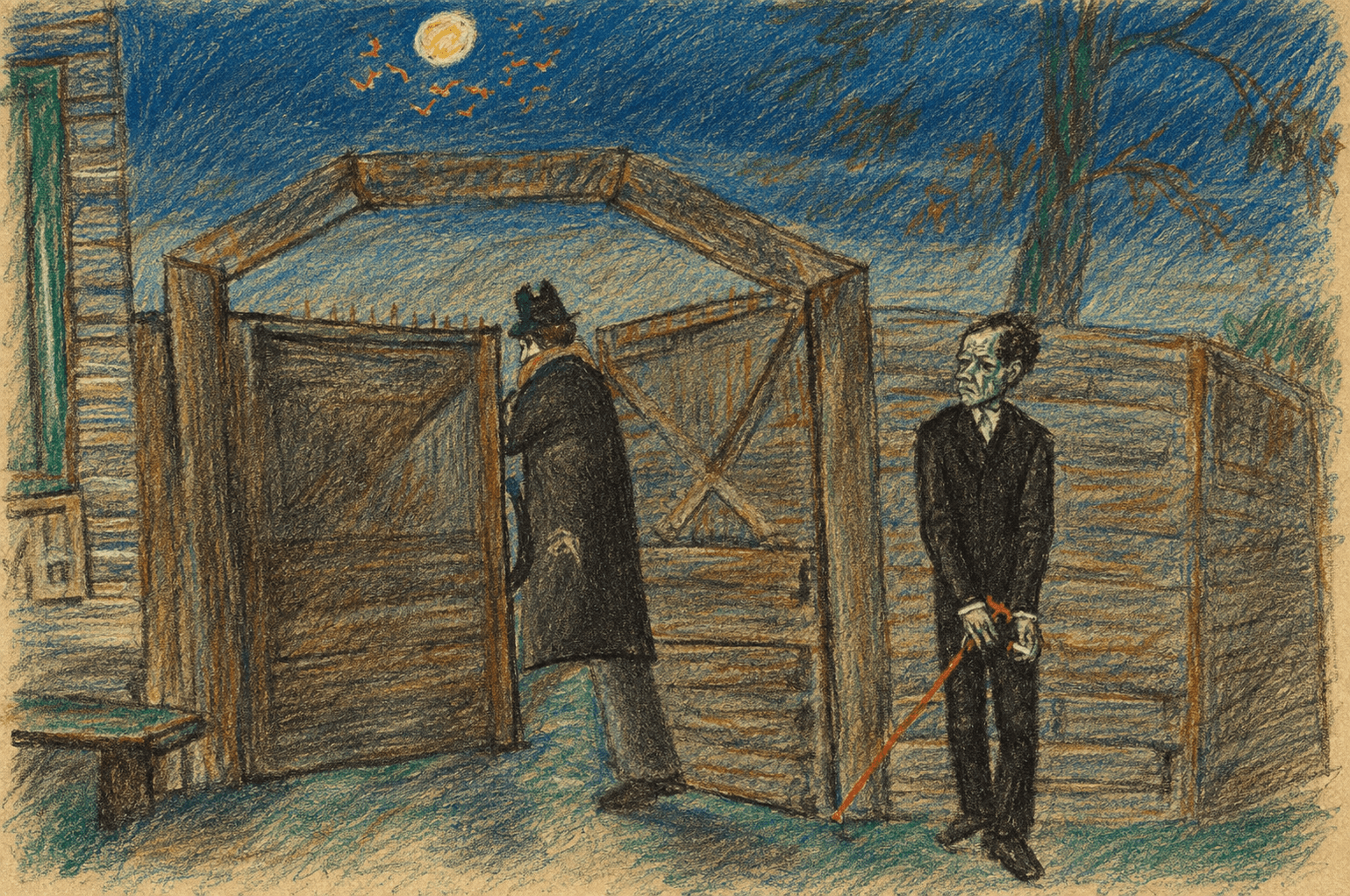
At the gate, Smerdyakov presses Ivan about leaving and describes how exposed the household may become. Ivan resents the suggestion that they understand each other without speaking plainly. Their conversation leaves an unanswered question behind him: can departing become a way of refusing to know?
Looking closely
The two figures stand apart against the wooden gate; the blue evening light leaves little warmth between them.
Remember this
Ivan hears more than he wants to acknowledge. Later, he must revisit both the words and his own decision to leave.
Illustration 26 is folded away: it comes from Bk V, ch. 6, past your place.
Movement V
A night of joy, a public judgment
The company at Mokroye gathers around desire and entertainment; the courtroom gathers around competing accounts. In both rooms, look at who watches and who must perform.
The party in Mokroye
Boris Grigoriev · Extract from the supplied collage
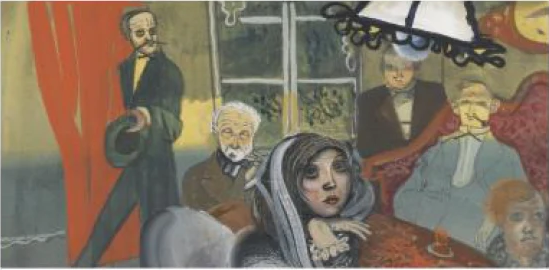
Dmitri reaches Mokroye to find Grushenka with the former lover whose return has unsettled her. Cards, money and awkward politeness fill the room before that reunion collapses. This gathering is a turning point for her, not simply another extravagant evening in Dmitri’s pursuit.
Looking closely
Grushenka occupies the foreground beneath the hanging lamp; the men behind her form a close, watchful company.
Remember this
Grushenka must judge the man she has remembered for years against the man who has actually returned to her.
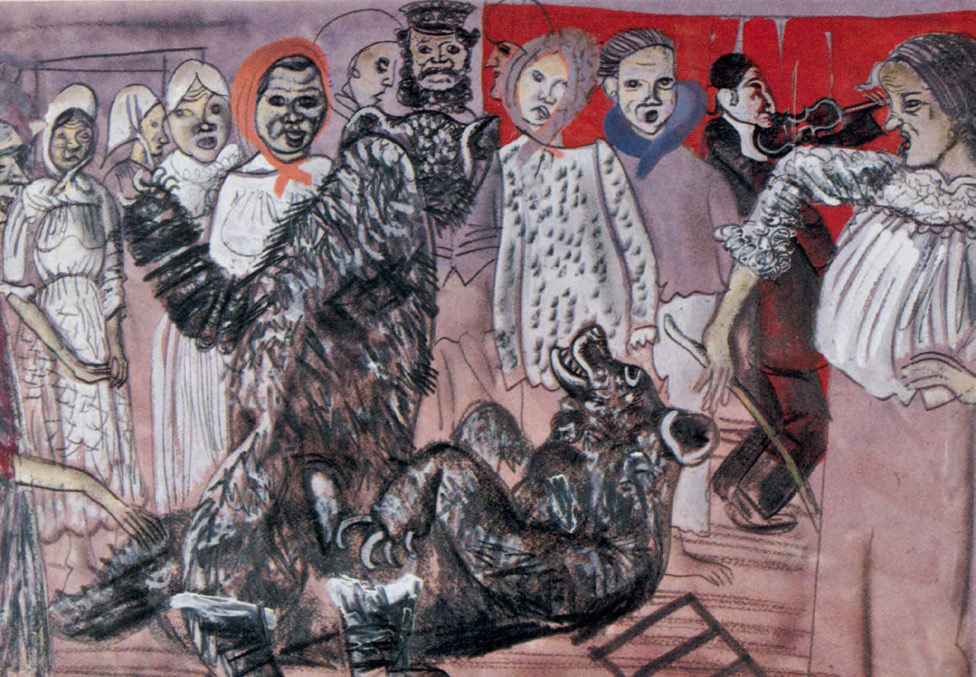
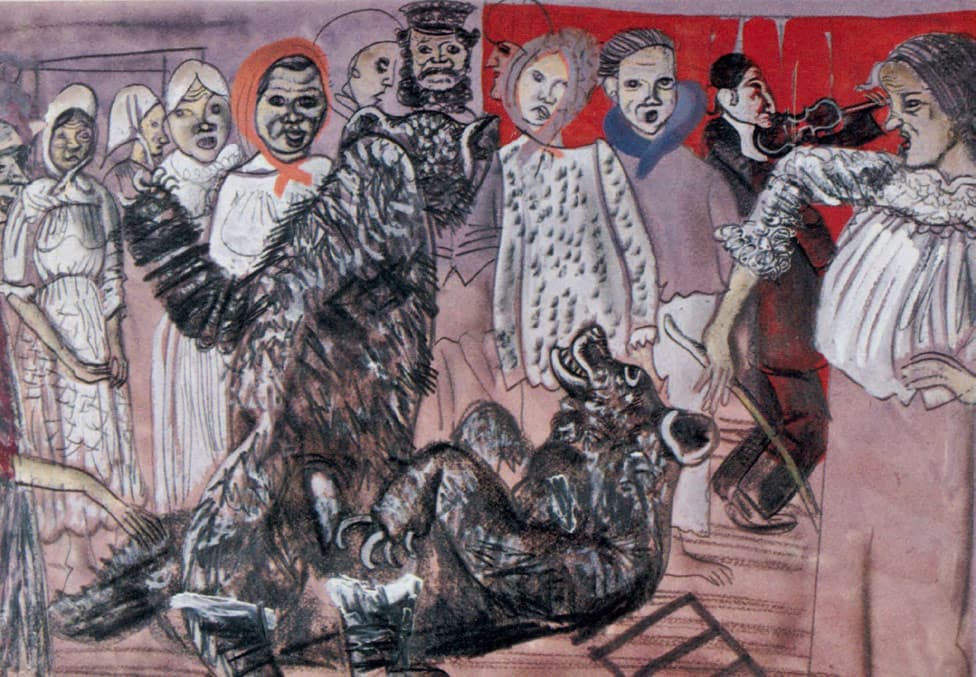
The party spills into songs and dancing; two girls perform dressed as bears. During the same night, Grushenka and Dmitri finally acknowledge their love. What feels like a beginning is interrupted by officials arriving to arrest him. The revelry and the catastrophe occupy the same room.
Looking closely
One bear-costumed performer stands while another sprawls beside an overturned chair; musicians and spectators press close behind them.
Remember this
The chapter’s delirium holds both happiness and dread. Their declaration of love does not cancel the violence outside the celebration.
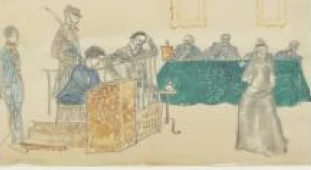
Katerina first tells the court how Dmitri helped her father, exposing her own humiliation to defend him. Later she produces his threatening letter. The testimony turns their intimate history into public evidence, while generosity, anger and the wish to protect Ivan pull her in different directions.
Looking closely
A solitary woman faces the long green-covered table; the seated officials and raised enclosure make the room feel divided.
Remember this
Remember the earlier bow. Katerina must now tell strangers what it meant, and her account can change Dmitri’s fate.
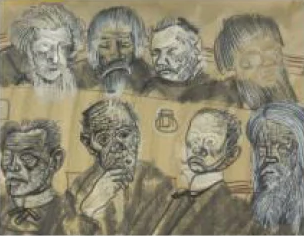
By the end of the trial, Dmitri’s life has been arranged into rival explanations. The jurors must decide which account to believe, and they convict him of the murder. These unnamed faces return the question to ordinary people: how easily can a persuasive story be mistaken for truth?
Looking closely
Heads fill two uneven rows, each with a different angle and expression; no single face commands the whole group.
Remember this
The verdict closes the trial, not the question of responsibility. Legal guilt and the novel’s moral reckoning are not identical.
Illustration 10 is folded away: it comes from Bk XII, ch. 14, past your place.
Pictures still awaiting their place
These 15 extracts are part of the same supplied collage, but their subjects have not been securely identified. They remain here as an illustrated appendix, not as scenes assigned a place in the story.
Inspect the 15 unconfirmed illustrations
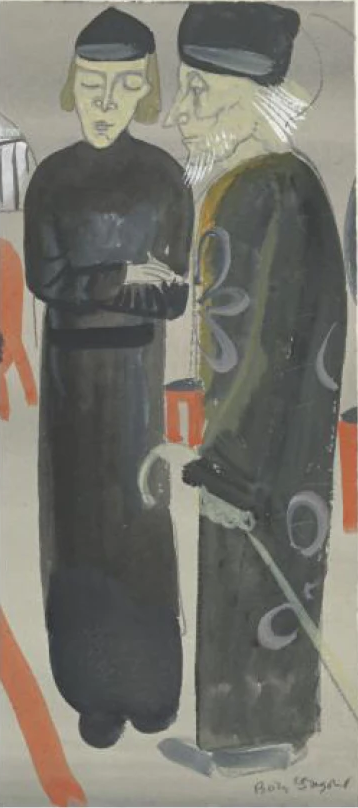
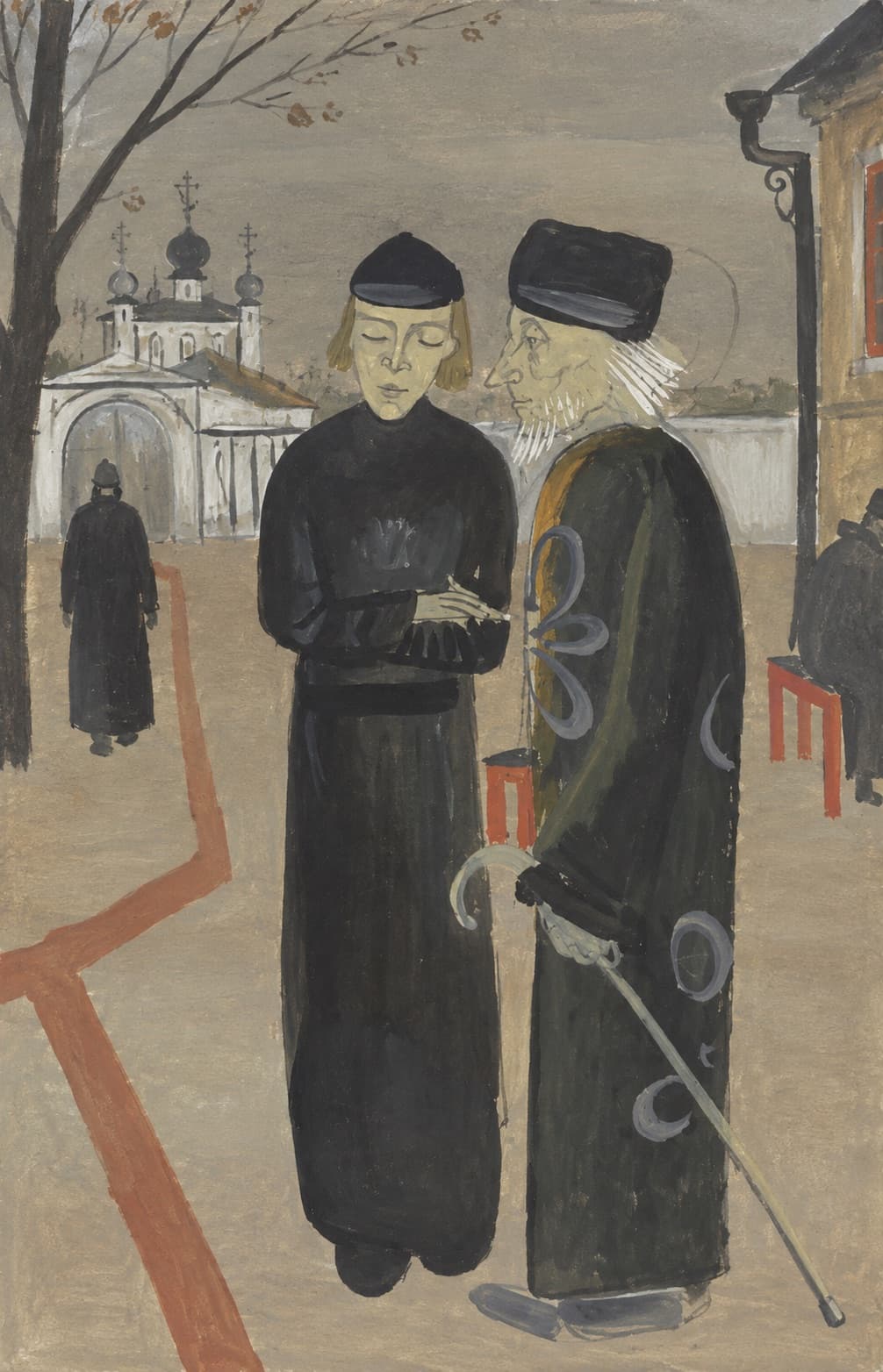
Two monks
Boris Grigoriev · Extract from the supplied collage
Open image ↗A generated study of this plate · AIAI-generated, not by Grigoriev — made from the small collage extract above, and not a restoration of it. It extends the picture beyond the extract: the monastery gate, the monk walking away, the benches and the building at the right are generated, not seen. Do not use it to identify the scene.
Illustration 08
Two monks
Probable match · not confirmed
Probably Alyosha with Zossima. The figures resemble their other portraits, but this particular composition has not been matched to a caption.
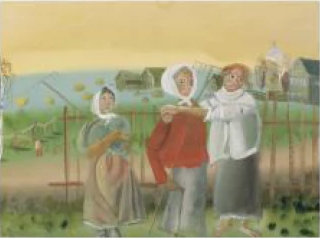
Three women outdoors
Boris Grigoriev · Extract from the supplied collage
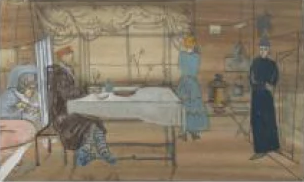
Three women stand beside a fence with the town beyond. Their identities are not established.
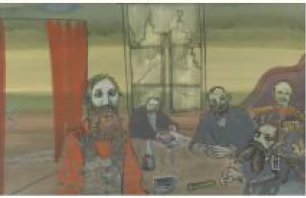
Men around a table
Boris Grigoriev · Extract from the supplied collage
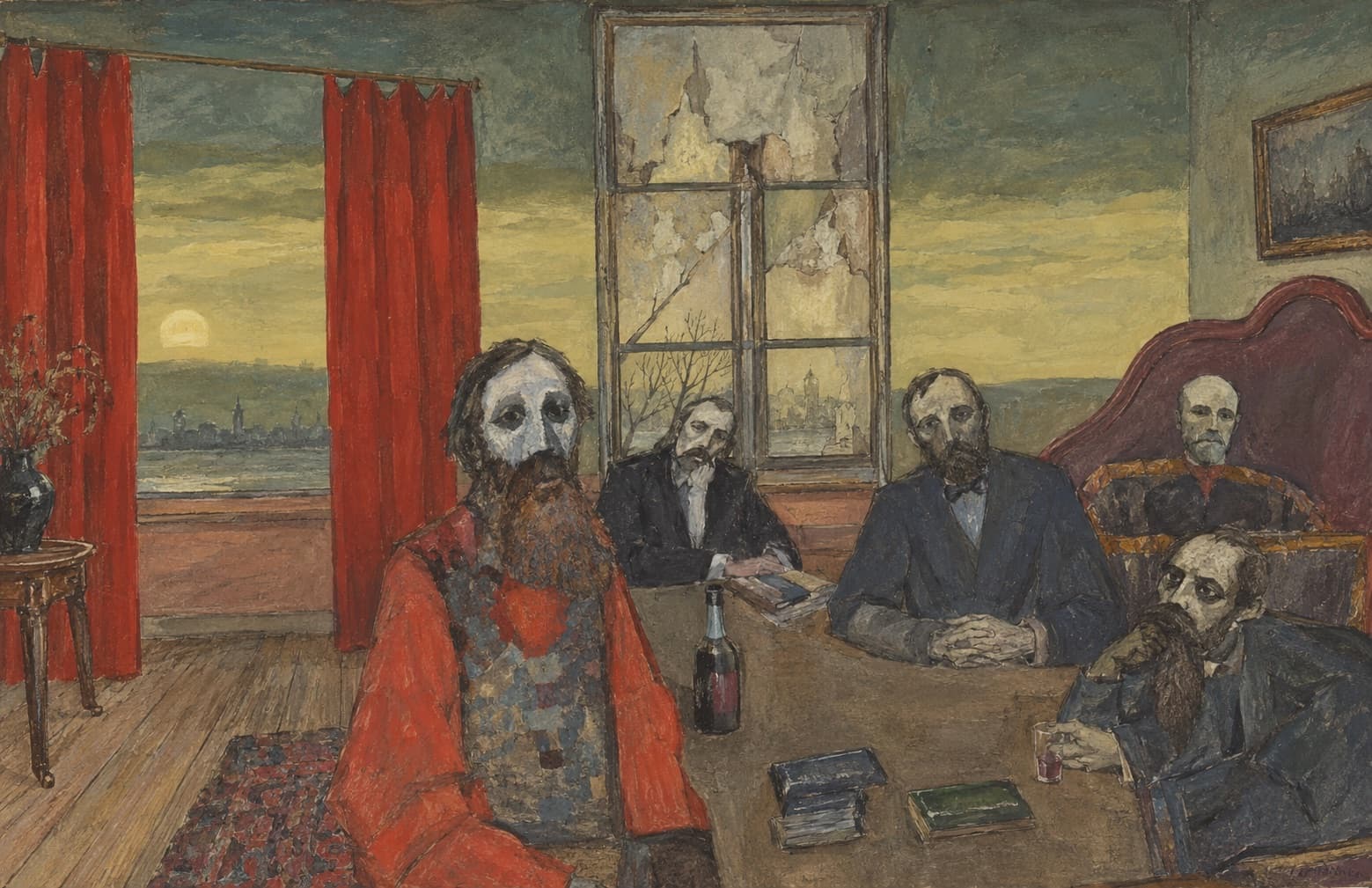
Open image ↗A generated study of this plate · AIAI-generated, not by Grigoriev — made from the small collage extract above, and not a restoration of it. The sunset, the town and river beyond the curtains, the cracked window, the rug and the signature are added, and the mask-like faces are repainted as realistic ones. Do not use it to identify the scene.
Illustration 11
Men around a table
Not yet identified
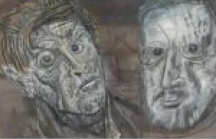
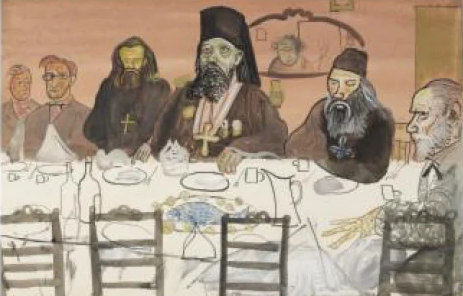
A group sits around a table in a room with red curtains. The exact episode remains unverified.
A man leaning toward a window
Boris Grigoriev · Extract from the supplied collage
Probably Fyodor Pavlovitch awaiting a visitor. The identification is a visual inference, not a verified catalogue title.
A bow in the monastery
Boris Grigoriev · Extract from the supplied collage
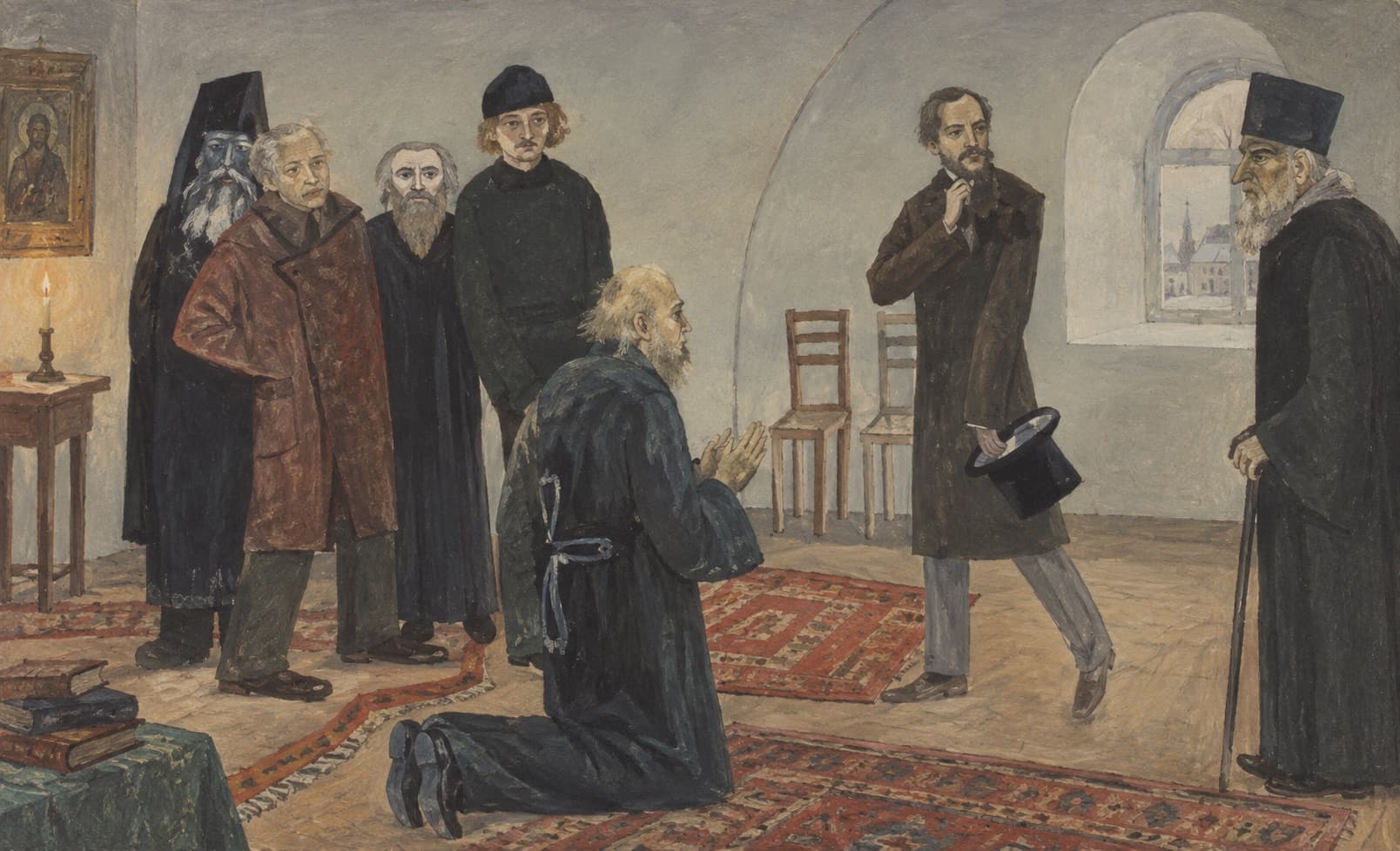
Open image ↗A generated study of this plate · AIAI-generated, not by Grigoriev — made from the small collage extract above, and not a restoration of it. The icon, candle, books, rugs and the snowy view through the window are added or elaborated, and every face is repainted. Do not use it to identify the scene.
Illustration 15
A bow in the monastery
Probable match · not confirmed
Probably Zossima bowing before Dmitri during the family’s visit. A caption for this exact image has not yet been verified.
A seated figure in red and white
Boris Grigoriev · Extract from the supplied collage
A bare-legged figure sits beside a pale object. The small reproduction does not support a confident character or scene identification.
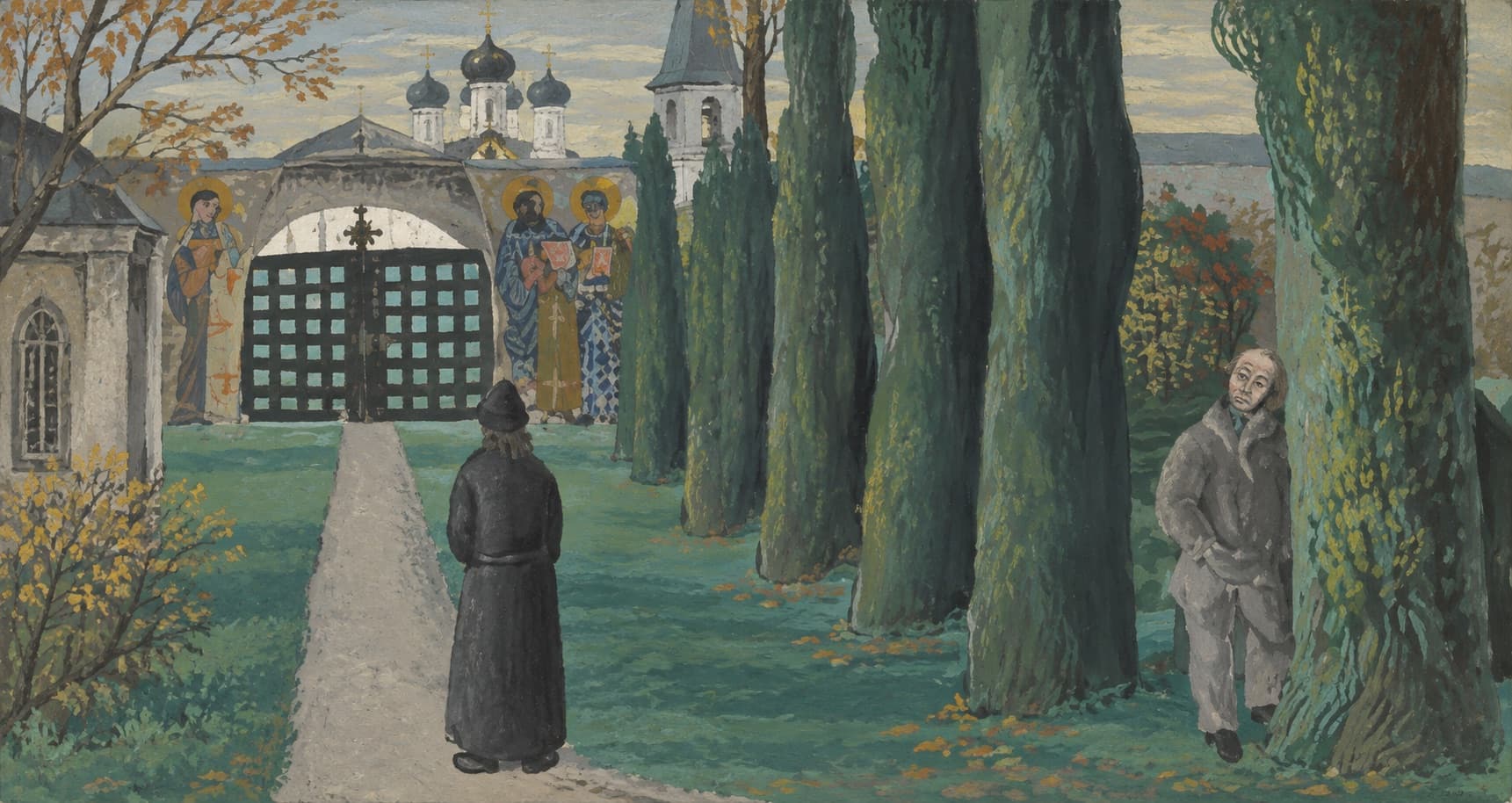
Two men on a monastery path
Boris Grigoriev · Extract from the supplied collage
Open image ↗A generated study of this plate · AIAI-generated, not by Grigoriev — made from the small collage extract above, and not a restoration of it. The church domes and bell tower, the detail of the painted saints and the texture of the trees are generated; the faces are repainted. Do not use it to identify the scene.
Illustration 20
Two men on a monastery path
Probable match · not confirmed
Probably Alyosha and Rakitin. A dark-robed figure and a man in a grey coat stand among the trees; the precise episode is unverified.
A figure on the earth at night
Boris Grigoriev · Extract from the supplied collage
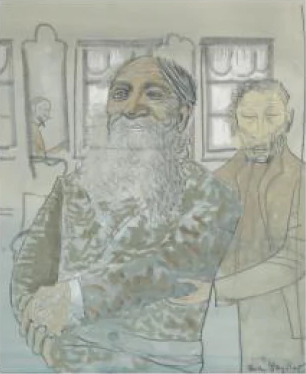
An old man with a long white beard sits with his hands folded; a younger man stands behind his chair. First read as Grigory and Marfa, but enlarged the standing figure looks like a man. Samsonov with his son (VIII.1) is another possibility. Neither is confirmed.
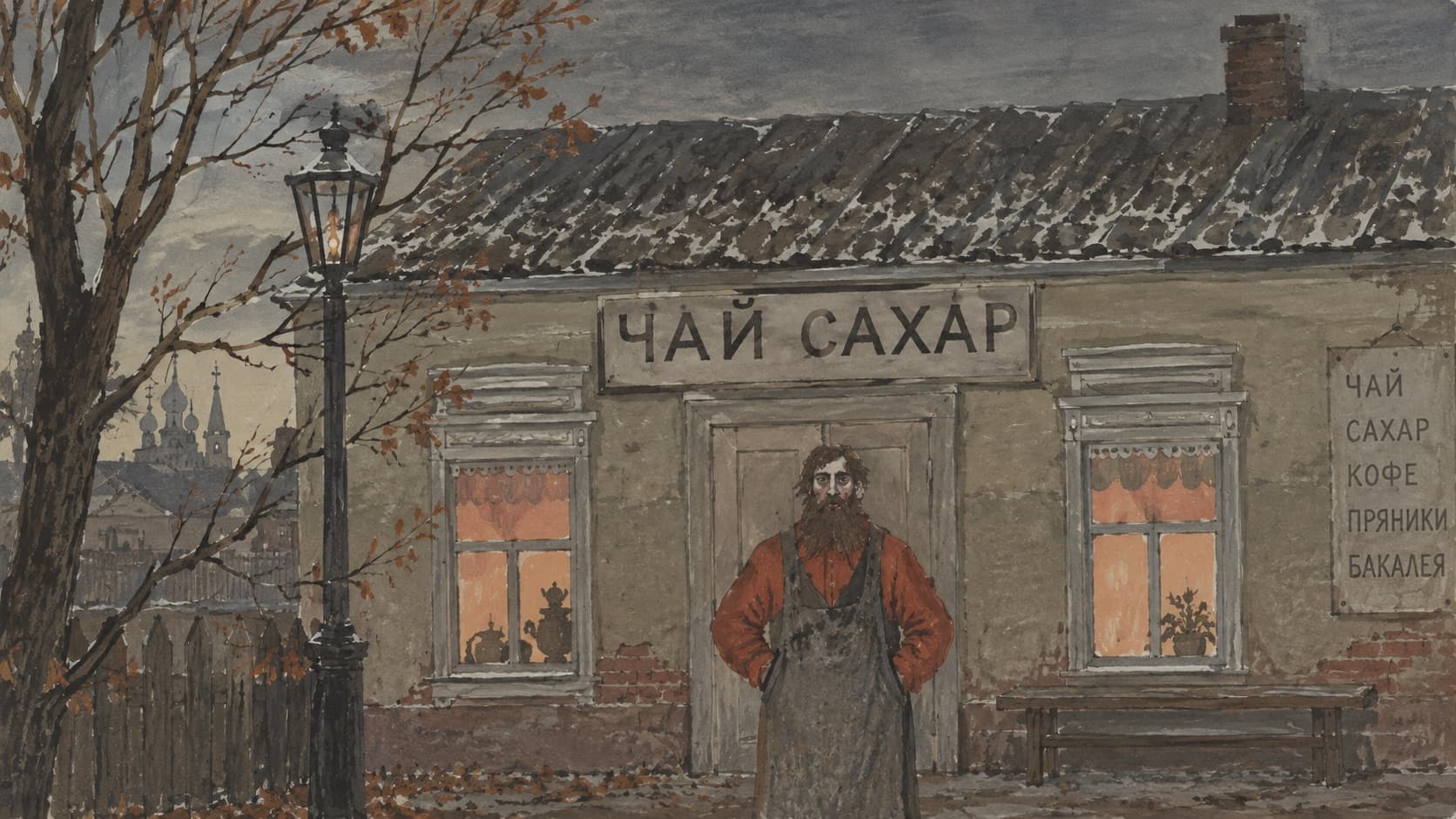
Outside a tea-and-sugar shop
Boris Grigoriev · Extract from the supplied collage
Open image ↗A generated study of this plate · AIAI-generated, not by Grigoriev — made from the small collage extract above, and not a restoration of it. The legible shop signs, the lamp post, the church skyline and a realistic face — in place of Grigoriev’s mask-like one — are all generated. Do not use it to identify the scene.
Illustration 32
Outside a tea-and-sugar shop
Not yet identified
A figure stands beneath a sign reading “Tea, Sugar.” The place and person remain unidentified.
A dim interior
Boris Grigoriev · Extract from the supplied collage
A hanging coat and a small window in a dim interior. This is not the magazine’s separately published “Ivan in his father’s house.”
The rest of the company
More lives in the novel
No separate portrait in this selection. Their stories still belong here.
Of the Schoolboys
Kolya Krassotkin
Thirteen — “fourteen in a fortnight”, he insists — brilliant and insufferable, repeating borrowed nihilism he half understands. An Ivan who can still be reached.
A widow’s only son, the boldest boy in his class, and the terror of his mother’s nerves.
Not yet met at your place in the book: first appears in Bk X, ch. 1.
A seminarist on the make and Grushenka’s cousin. Explains everyone by their motives, takes twenty-five roubles to bring the grieving Alyosha to her, and turns up at the trial with a theory.
A seminarist and Alyosha’s friend — clever, ambitious, and quick to explain everyone by their lowest motive.
Not yet met at your place in the book: first appears in Bk II, ch. 7.
Fyodor’s servant for decades, and the man who actually raised the sons. He is struck down with a pestle on the night of the murder, and his evidence that the garden door stood open is the most damning at the trial.
Fyodor’s old servant — gloomy, obstinate and honest — who looked after each of the boys when their father would not.
Not yet met at your place in the book: first appears in Bk I, ch. 2.
A schoolboy who bit Alyosha’s finger because his father had been dragged through the street by the beard. He dies at nine, and the novel ends at his funeral.
A small, sick schoolboy of about nine who fights a whole gang of boys alone — and bites Alyosha’s finger.
Not yet met at your place in the book: first appears in Bk IV, ch. 3.
The young official holding Dmitri’s pistols as a pledge. Alarmed by his bloodstained hands and sudden money, he follows the trail that brings the authorities to Mokroye.
Pyotr Ilyitch Perhotin, the young official with whom Dmitri has pawned his pistols.
Not yet met at your place in the book: first appears in Bk VIII, ch. 5.
A wealthy widow of enthusiasms, comic and useless. Lise’s mother — and the one who sends Dmitri chasing gold-mines when he needs three thousand roubles.
A rich, excitable widow who has brought her invalid daughter to see the elder.
Not yet met at your place in the book: first appears in Bk II, ch. 3.
Ilusha’s father. Destitute, and humiliated in front of his son by Dmitri. He tramples the money that would save his family because his boy is watching.
Ilusha’s father, a destitute former captain who plays the buffoon to cover his shame.
Not yet met at your place in the book: first appears in Bk IV, ch. 6.
Mention counts with aliases resolved — Dmitri, Mitya, Mitka and Dmitri Fyodorovitch counted as one person. Overlapping names are claimed longest-first, so nothing is double-counted.
![The published composition is titled “The Little Demon [Lise Hohlakov and Alyosha].” This collage includes only a portion of it; Alyosha is outside the visible crop.](/artwork/grigoriev-collage/plate-24.png)
![Published as “For a while a very obscure one [Ivan and Smerdyakov].” Their conversation surrounds Ivan’s departure.](/artwork/grigoriev-collage/plate-26.png)